Part 1
The first words my mother said to me in nineteen years were not “I’m sorry.”
They weren’t “How have you been?” or “You look well,” or even “Hello, Rachel.”
She stood in the middle of my living room, forty-one floors above Manhattan, with my father at her shoulder and the October rain streaking down the windows behind them, and she said:
“We need one million dollars. And you’re going to give it to us, because Brooke is still your sister.”
I was thirty-five years old. I had built a commercial real estate firm from a borrowed desk in a shared office in Queens to a company with offices on two coasts. I had sat across negotiating tables from men who made grown executives sweat. And for one strange, silent second, standing barefoot on my own hardwood floor, I felt sixteen again.
Then the feeling passed.
Diane and Richard Hale had vanished from my life when I was a teenager. Not drifted. Not grown apart. Vanished, the way people do when they decide you are no longer worth the trouble of keeping. And now they had walked into my home, past my doorman and up my private elevator, as though nineteen years of silence were a misunderstanding about a dinner reservation.
My father looked older. His hair had gone fully gray, and the expensive navy overcoat he wore had begun to shine at the cuffs. My mother looked exactly the same, which somehow felt worse. Same pearl earrings. Same tight mouth. Same way of looking at a room as if she were pricing everything in it.
Her eyes moved over my furniture, my art, the view. They did not linger on me.
My father set a thick manila folder on my glass coffee table and squared it with his fingertips, the way he used to straighten the placemats before guests arrived.
“Your sister made a mistake,” he said. “A financial one. There’s an audit starting soon. If the money is replaced before it begins, this whole thing goes away quietly. Nobody gets hurt.”
“And why,” I asked, “would I be the one to fix it?”
My mother let out a short, bitter laugh.
“Because you owe this family.”
I didn’t answer right away. Instead, I looked down.
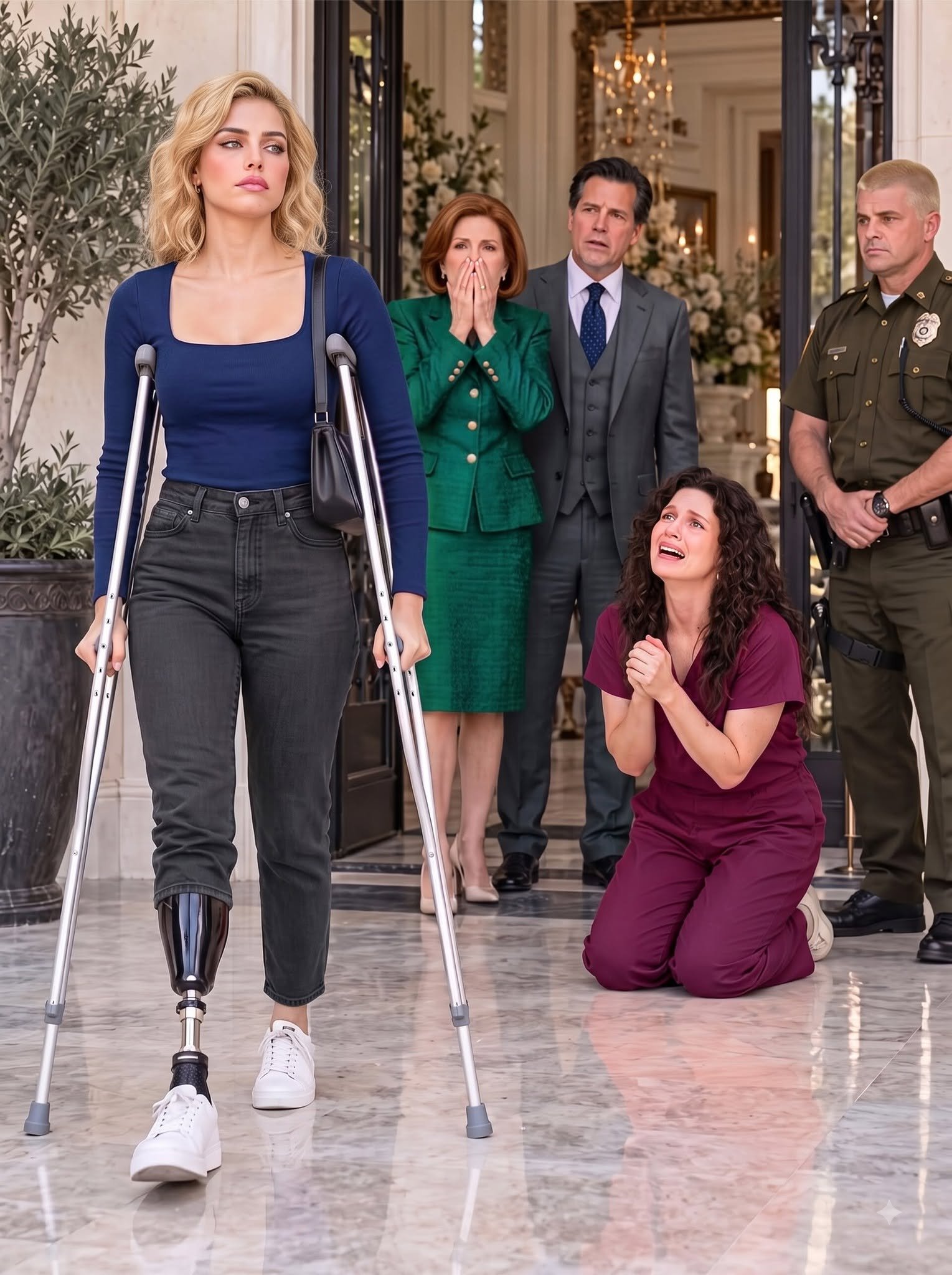
Below the hem of my charcoal trousers, the titanium of my prosthetic leg caught the gray light from the windows. I touched the cool metal with two fingers, the way some people touch a ring when they’re nervous. It wasn’t nerves. It was memory.
“I owe you,” I repeated.
It would have been funny if the history behind it hadn’t been so ugly.
I was ten years old when the pain in my left knee stopped being “growing pains.”
By the time the doctors found the tumor, it had already wrapped itself into the bone. Osteosarcoma, they called it. Aggressive. Fast. The kind of word that makes adults lower their voices in hallways. The surgeons took my leg above the knee to save my life, and I woke up in a pediatric recovery room with a blanket lying flat where my leg should have been.
I remember crying for my mother.
I remember the nurse stroking my hair and saying, “She’s coming, sweetheart. She’s on her way.”
And I remember that when Diane finally arrived, she didn’t come to the side of the bed. She stood at the foot of it, still holding her car keys, and stared at the empty space beneath the blanket for a long time.
Then she said, to no one in particular:
“What are we supposed to do with you now?”
I was ten. I didn’t have words for what that sentence did to me. I only knew that something between us had closed, like a door you hear shut somewhere in the house while you’re falling asleep.
From that day on, I stopped being a daughter in that house. I became a problem to be managed.
My little sister, Brooke, was seven when I came home on crutches. She was blonde and quick and loved to perform, and my parents poured everything into her. Ballet three days a week. Private skating lessons. Birthday parties with rented ponies and catered cupcakes. Spring breaks in Turks and Caicos.
I asked for a proper prosthetic — not a fancy one, just a functioning one that didn’t rub my skin raw — and my father told me it was “an unnecessary expense.” I had crutches, didn’t I? I could get around the house fine.
When guests came over, my mother would find me before the doorbell rang.
“Go upstairs, Rachel. People will ask questions, and I don’t want to spend the whole evening talking about your leg.”
So I went upstairs. I listened to the laughter drifting up through the floorboards. I did my homework on my bed and taught myself how to fall without hurting my hands. By sixteen, I understood exactly how my family worked. Appearances mattered. I did not.
The end came on an ordinary Saturday in October.
My mother had hired a photographer for the family Christmas card, which she always shot early so the prints would be ready by Thanksgiving. The living room had been staged like a magazine spread: white roses, cream throw pillows, and a brand-new white wool rug she had ordered from a designer in Connecticut.
I was supposed to stand at the back, behind the sofa, where my crutches wouldn’t show.
As I moved into position, the rubber tip of my left crutch slid on the freshly polished hardwood. I caught myself on the side table, but my elbow struck a glass of red wine my father had set down.
I still remember how slowly it seemed to fall.
The wine hit the white rug and spread outward in a dark, ugly bloom.
Nobody asked if I was okay. Nobody asked if I’d hurt myself, even though I’d wrenched my shoulder catching the table.
My father looked at the stain. Then he looked at me. Then he walked into the kitchen, and I heard a drawer open and close.
He came back holding a black trash bag.
“We’re tired of carrying you,” he said, and held it out. “Get your things and go.”
I laughed, actually laughed, because I thought it had to be a cruel joke. Then I saw his face.
I looked at my mother. I kept waiting for her to say Richard, stop, the way mothers do in movies. Instead, she walked to the front door and opened it.
Brooke was curled on the loveseat with her phone. She didn’t look up. Not once.
I went upstairs on my crutches and stuffed three changes of clothes, my school binder, and a framed picture of my grandmother into that trash bag. Then I came back down, one step at a time, and walked out into the cold rain.
Nobody called after me.
I walked almost two miles on crutches, with that bag looped around my wrist and banging against my good leg, to the only person I could think of. My mother’s older sister, Ruth. My parents hadn’t spoken to her in years — something about Ruth having “opinions” about how they raised their children.
When she opened her door and saw me standing on her porch, soaked and shaking, she didn’t ask a single question.
She just said, “Get in here, baby,” and pulled me inside.

I’d like to say that being thrown out was the worst thing my parents ever did to me.
It wasn’t.
Two years later, at eighteen, I applied for a student loan. I’d gotten into college with a partial scholarship, and I wanted — more than anything — to show up on campus with a real prosthetic leg. A good one. One that would let me walk across a quad without anyone staring at my crutches.
The loan officer frowned at her screen for a long time.
“Ms. Hale,” she said carefully, “there’s a significant amount of delinquent debt under your Social Security number.”
More than forty thousand dollars.
Credit cards I had never seen. A personal loan I had never signed. Store accounts at luxury boutiques. A line of credit opened when I was fourteen years old, sitting upstairs with my homework while laughter floated up through the floor.
My parents had stolen my identity. They had used my name to pay for Brooke’s ballet costumes, her designer clothes, her sweet sixteen, and an entire semester in Florence.
The daughter they couldn’t be bothered to buy a working leg for had been quietly financing her sister’s dream life.
It took me years of lawyers, police reports, credit disputes, and working nights at a hotel front desk to dig myself out. But I did. I got the debt cleared. I got the leg. I got the degree. I got a job as an assistant at a real estate brokerage, then a license, then my own small firm, then a bigger one.
By thirty-five, I had a life that required absolutely nothing from the people who had thrown me away.
And now, here they were, standing in it, asking for a million dollars.
I walked across the room to my private elevator and pressed the call button. The soft chime echoed through the apartment.
“Get out,” I said.
My mother’s face twisted with fury.
“If Brooke goes to federal prison, it will be on your head.”
The elevator doors slid open. My father picked up his folder. My mother walked past me without looking at my leg, the same way she’d always managed not to look at it.
As the doors began to close between us, I said quietly:
“No. It will be on whatever Brooke did.”
The doors shut.
I stood alone in my living room for a long time, listening to the rain.
Then I picked up my phone and called a man named Frank Delaney. He was a former NYPD detective who now did quiet investigative work for my firm, mostly background checks on developers and partners who seemed a little too eager to close.
“Frank,” I said. “I need you to find out everything about my sister. Fast.”
Three days later, he walked into my office and closed the door behind him. He didn’t sit down. He set a thick dossier on my desk and looked at me with an expression I’d never seen on his face before.
“Rachel,” he said, “this isn’t about a bookkeeping mistake.”
“Then what is it about?”
He opened the folder to a photograph of a young woman with dark hair and a bright, open smile.
“Your sister is trying to bury what happened to a twenty-four-year-old woman who may never walk again.”
And for the first time, I understood. My parents hadn’t come back because they missed me. They hadn’t come back because Brooke needed money.
They had come back because they were terrified of what the world was about to find out.